First, we need to know who is logged in. This can be done using the who command which retrieves all logged in users.
$ who

To send a message you need the username and his current terminal.
You need to know if messages are allowed or not for that user using the mesg command.
$ mesg

If the result shows “is y” that means messaging is permitted. If the result shows “is n”, that means messaging is not permitted.
To check any logged user message status, use the who command with -T option.
$ who –T
If you see a dash (-) that means messages are turned off and if you see plus sign (+) that means messages are enabled.
To allow messages, type mesg command with the “y” option like this:
$ mesg y
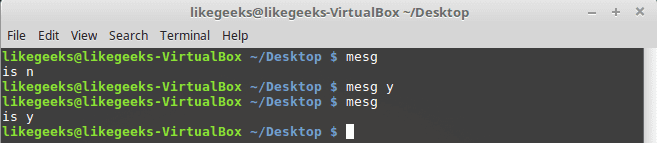
Sure enough, it shows “is y” which means messages are permitted for this user.
Of course, we need another user to be able to communicate with him so in my case I’m going to connect to my PC using SSH and I’m already logged in with my user, so we have two users logged onto the system.
Let’s see how to send a message.
Write Command
The write command is used to send messages between users using the username and current terminal.
For those users who logged into the graphical environment (KDE, Gnome, Cinnamon or any), they can’t receive messages. The user must be logged onto the terminal
We will send a message to testuser user from my user likegeeks like this:
$ write testuser pts/1
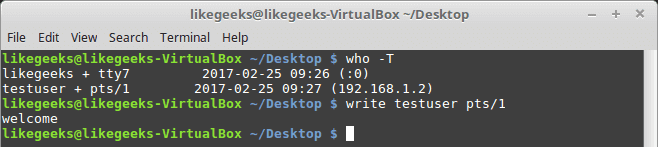
Type the write command followed by the user and the terminal and hit Enter.
When you hit Enter, you can start typing your message. After finishing the message, you can send the message by pressing the Ctrl+D key combination which is the end of file signal. I recommend you to review the post about signals and jobs.

The receiver can recognize which user on which terminal sends the message. EOF means that the message is finished.
I think now we have all the parts to build our shell script.
Creating The Send Script
Before we create our shell script, we need to determine whether the user we want to send a message to him is currently logged on the system, this can be done using who command to determine that.
logged=$(who | grep -i -m 1 $1 | awk '{print $1}')
We get the logged user using the grep command. The -m 1 option is used in case there are multiple sessions opened for the same user.
If the user is not online, the grep command returns either nothing.
This output is piped to the awk command. The awk command returns only the first item. The final output from the awk command is stored in the variable logged_on.
Then we need to check the variable if it contains something or not:
if [ -z $logged ]
then
echo "$1 is not logged on."
echo "Exit"
exit
fi
I recommend you to read the post about the if statement and how to use it Bash Script.
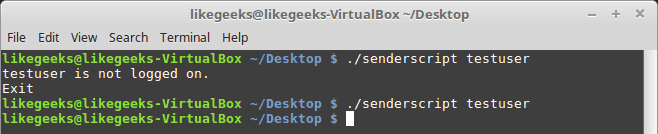
The logged variable is tested to check if it is a zero or not.
If it is zero, the script prints the message, and the script is terminated.
If the user is logged, the logged_on variable contains the username.
Checking If The User Accepts Messages
To check if messages are allowed or not, use the who command with -T option.
check=$(who -T | grep -i -m 1 $1 | awk '{print $2}')
if [ "$check" != "+" ]
then
echo "$1 disable messaging."
echo "Exit"
exit
fi
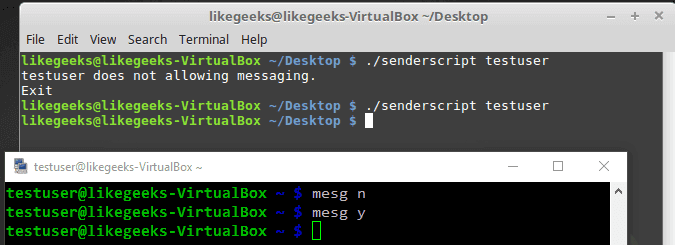
Notice that we use the who command with -T. This shows a (+) beside the username if messaging is permitted. Otherwise, it shows a (-) beside the username, if messaging is not permitted.
Finally, we check for a messaging indicator if the indicator is not set to plus sign (+).
Checking If Message Was Included
You can check if the message was included or not like this:
if [ -z $2 ]
then
echo "Message not found"
echo "Exit"
exit
fi
Getting the Current Terminal
Before we send a message, we need to get the user current terminal and store it in a variable.
terminal=$(who | grep -i -m 1 $1 | awk '{print $2}')
Then we can send the message:
echo $2 | write $logged $terminal
Now we can test the whole shell script to see how it goes:
$ ./senderscript likegeeks welcome
Let’s see the other shell window:
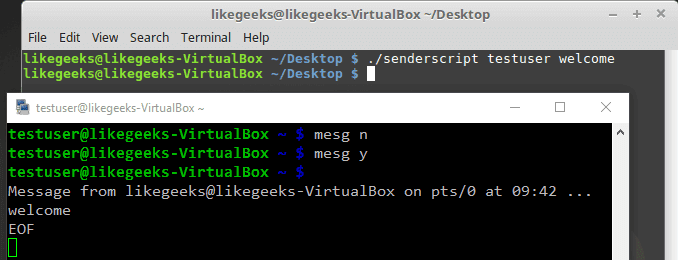
Good! You can now send a simple one-word messages.
Sending a Long Message
If you try to send more than one word:
$ ./senderscript likegeeks welcome to shell scripting
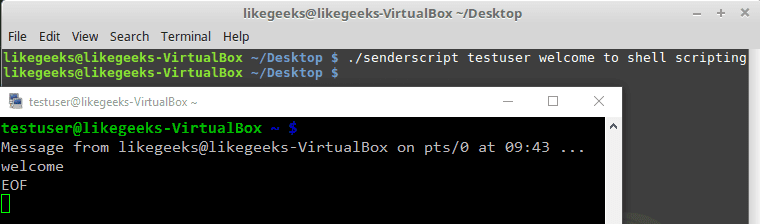
It didn’t work. Only the first word of the message is sent.
To fix this problem, we will use the shift command with the while loop.
shift
while [ -n "$1" ]
do
message=$message' '$1
shift
done
And now one thing needs to be fixed, which is the message parameter.
echo $whole_message | write $logged $terminal
So now the whole script should be like this:
#!/bin/bash
logged=$(who | grep -i -m 1 $1 | awk '{print $1}')
if [ -z $logged ]
then
echo "$1 is not logged on."
echo "Exit"
exit
fi
check=$(who -T | grep -i -m 1 $1 | awk '{print $2}')
if [ "$check" != "+" ]
then
echo "$1 disable messaging."
echo "Exit"
exit
fi
if [ -z $2 ]
then
echo "Message not found"
echo "Exit"
exit
fi
terminal=$(who | grep -i -m 1 $1 | awk '{print $2}')
shift
while [ -n "$1" ]
do
message=$message' '$1
shift
done
echo $message | write $logged $terminal
If you try now:
$ ./senderscript likegeeks welcome to shell scripting
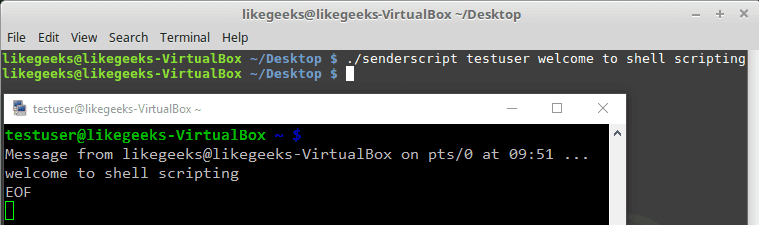
Awesome!! It worked. Again, I’m not here to make a script to send the message to the user, but the main goal is to review our shell scripting knowledge and use all the parts we’ve learned together and see how things work together.
Monitoring Disk Space
Let’s build a script that monitors the biggest top ten directories.
If you add -s option to the du command, it will show summarized totals.
$ du -s /var/log/
The -S option is used to show the subdirectories totals.
$ du -S /var/log/
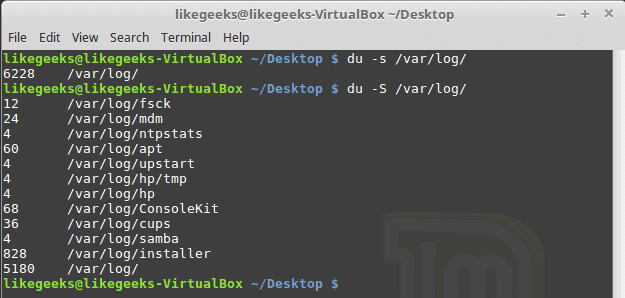
You should use the sort command to sort the results generated by the du command to get the largest directories like this:
$ du -S /var/log/ | sort -rn
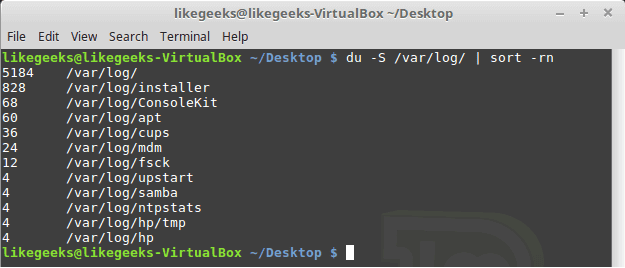
The -n to sort numerically and the -r option to reverse the order so it shows the bigger first.
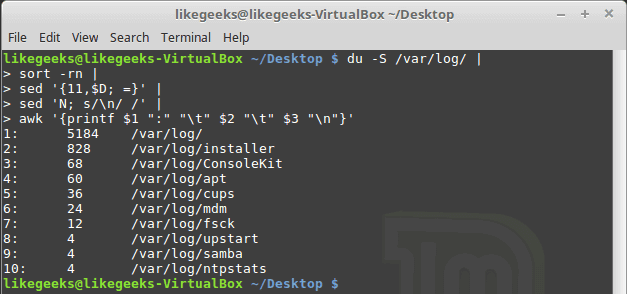
The N command is used to label each line with a number:
sed '{11,$D; =}' |
sed 'N; s/\n/ /' |
Then we can clean the output using the awk command:
awk '{printf $1 ":" "\t" $2 "\t" $3 "\n"}'
Then we add a colon and a tab so it appears much better.
$ du -S /var/log/ |
sort -rn |
sed '{11,$D; =}' |
# pipe the first result for another one to clean it
sed 'N; s/\n/ /' |
# formated printing using printf
awk '{printf $1 ":" "\t" $2 "\t" $3 "\n"}'
Suppose we have a variable called MY_DIRECTORIES that holds 2 folders.
MY_DIRECTORIES=”/home /var/log”
We will iterate over each directory from MY_DIRECTORIES variable and get the disk usage using du command.
So the shell script will look like this:
#!/bin/bash
MY_DIRECTORIES="/home /var/log"
echo "Top Ten Directories"
for DIR in $MY_DIRECTORIES
do
echo "The $DIR Directory:"
du -S $DIR 2>/dev/empty |
sort -rn |
sed '{11,$D; =}' |
# pipe the first result for another one to clean it
sed 'N; s/\n/ /' |
# formated printing using printf
awk '{printf $1 "\t" "\t" $2 "\t" $3 "\r\n"}'
done
exit
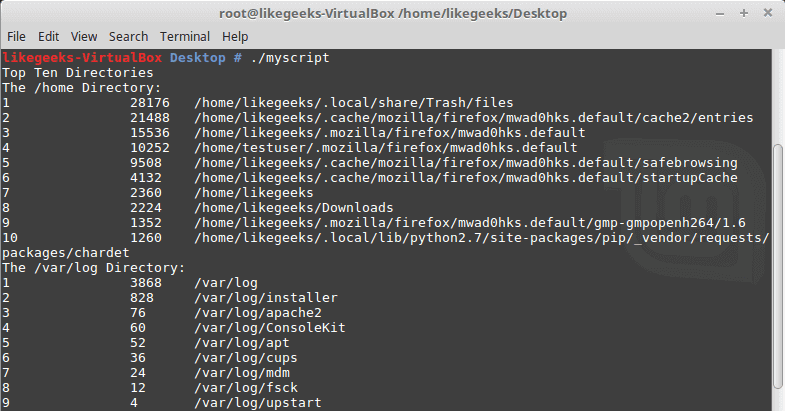
Good!! Both directories /home and /var/log are shown on the same report.
You can filter files, so instead of calculating the consumption of all files, you can calculate the consumption for a specific extension like *.log or whatever.
One thing I have to mention here, in production systems, you can’t rely on disk space report instead, you should use disk quotas.
Quota package is specialized for that, but here we are learning how bash scripts work.
Again the shell scripts we’ve introduced here is for showing you how shell scripting work, there are a ton of ways to implement any task in Linux.
My post is finished for now. I tried to reduce the post length and make everything simple as possible, hope you like it.
Keep coming back. Thank you.
likegeeks.com


 “Tyche” kod adlı 4.7 kararlı sürümü 19 Kasım 2017‘de duyurulan SparkyLinux’un Debian 9 “Stretch”e dayalı olarak gelen 4.7 armhf sürümü duyuruldu. Küçük bir uygulama setiyle Openbox ile ya da CLI (metin tabanlı) olarak kullanıma sunulan sürümde, bilinen tüm sorunların düzeltildiği söyleniyor. “pcmanfm” dosya yöneticisinin “thunar” ile değiştirildiği belirtilirken, “uget” indirme yöneticisinin de metin tabanlı “aria2” ile değiştirildiği ifade ediliyor. “netsurf” web tarayıcısının tercih edildiği sistemde, paket yöneticisi aracılığıyla favori web tarayıcılarının yüklenebileceği belirtiliyor. SparkyLinux 4.7 armhf hakkında ayrıntılı bilgi edinmek için sürüm duyurusunu inceleyebilirsiniz.
 Emacs ve Vi editörü,
  Penetrasyon testleri ve güvenlik araştırmacıları için tasarlanmış
  MythTV ile yapılandırılan ve basit bir ev sineması PC’si oluşturmayı amaç edinen Arch Linux
  GNU/
GNU/ In the last post, we talked about
  Açık kaynak kodlu bir fotoğraf uygulaması ve RAW geliştiricisi olan